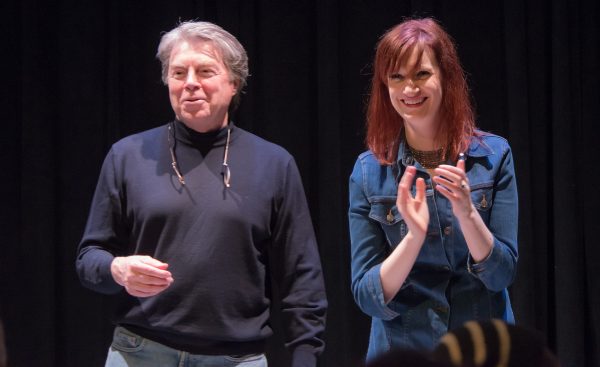
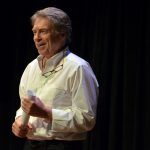
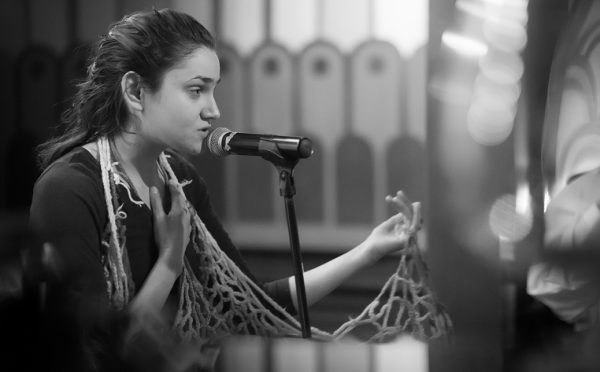
AWoW Co-Founder Niamh Hyland with Michael Brunnock
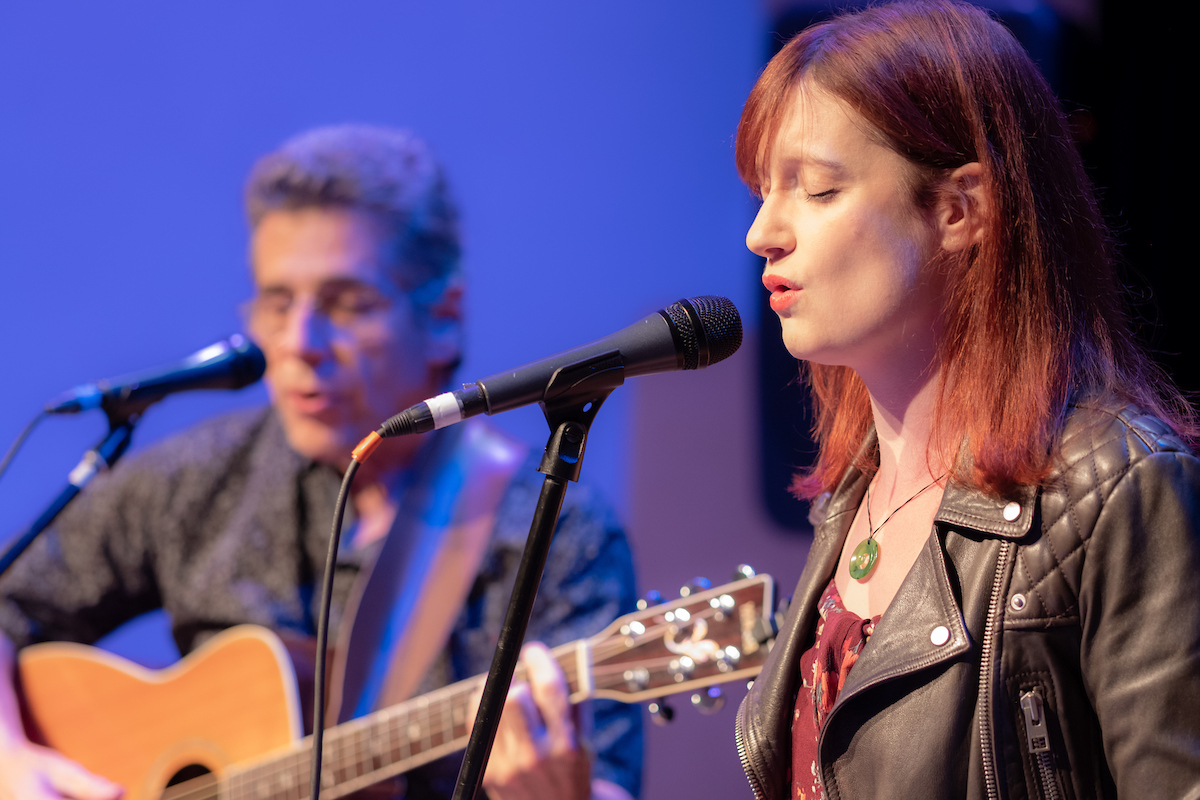
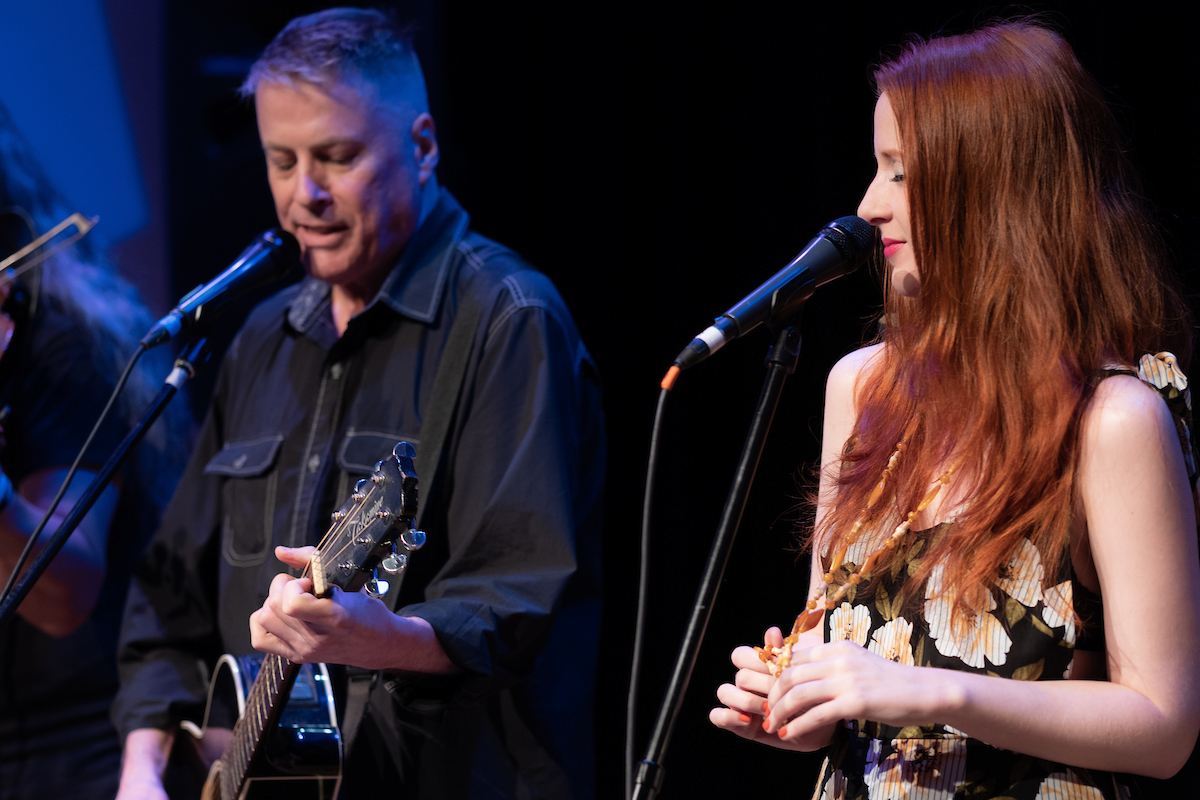
Artists Without Walls’ co-founder Niamh Hyland along with longtime collaborator Michael Brunnock, are set to release their first album, entitled “Live to Love.”
Hyland & Brunnock will be holding an album release party at Rockwood Music Hall, Stage 2, on Oct. 25, 2018. Click here for tickets.
As most artists, with or without walls, know all too well, it isn’t easy nor is it cheap to produce art in this era. Hyland & Brunnock have kicked off a crowdfunding campaign to help offset the significant expense of professionally producing their new album.
I just wanted to drop a line to express my sheer joy attending last night’s performances.
I literally laughed & cried.
Every single performance was given & accepted in such a heartfelt manner. I was proud to be part of this nurturing environment.
Thank you,
Debi Javier
—–
Niamh and Charles,
The ART community is so very lucky to have your dedication, passion and energy in their corner…with or without walls.
Thank you for another really special night at AWoW. And thank you for continuing to provide this incredible platform where artistic gifts, hugs, tears, laughter and hope are shared. AWoW ….WOW.
.
This embracing community of richly talented artists sharing their gifts with us; an appreciative supportive audience , makes Tuesday nights very special indeed.
.
Each diverse performer brought something that each of us could hold close. So happy we could be there last night.
.
All the best,
clyde berger
.
David Goldman and Niamh Hyland
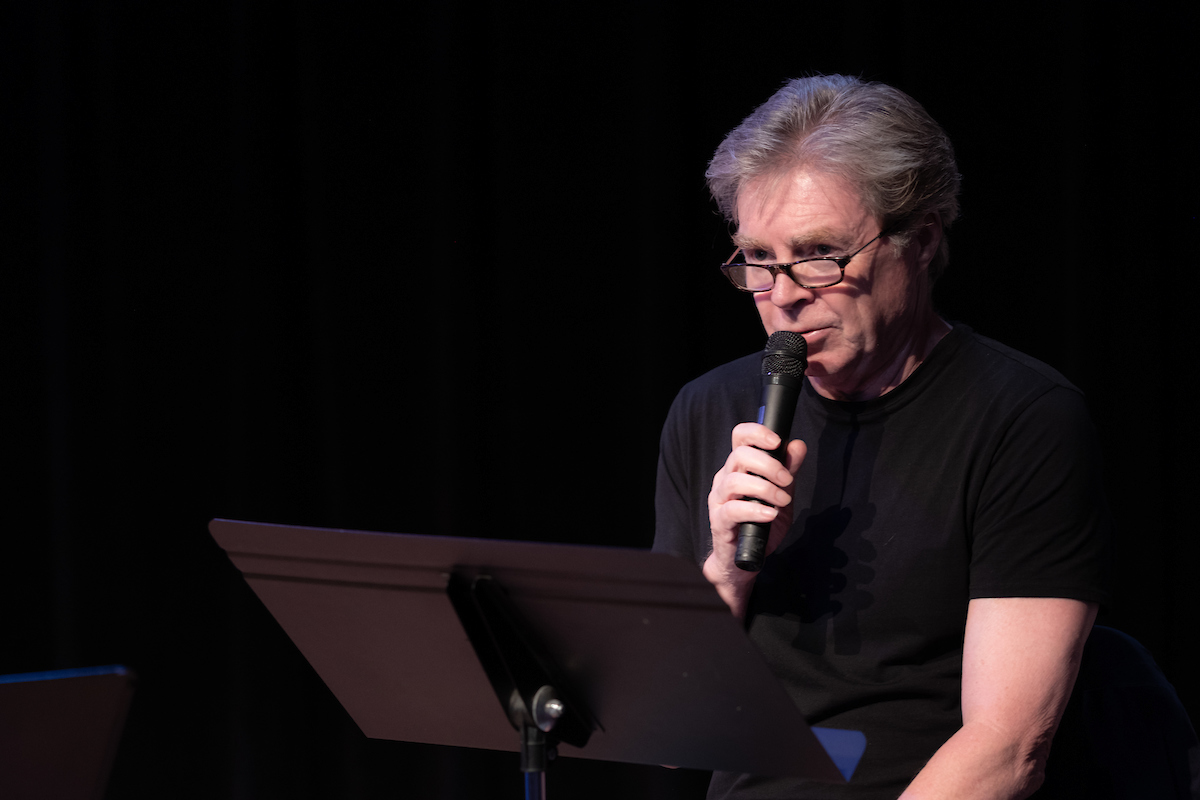
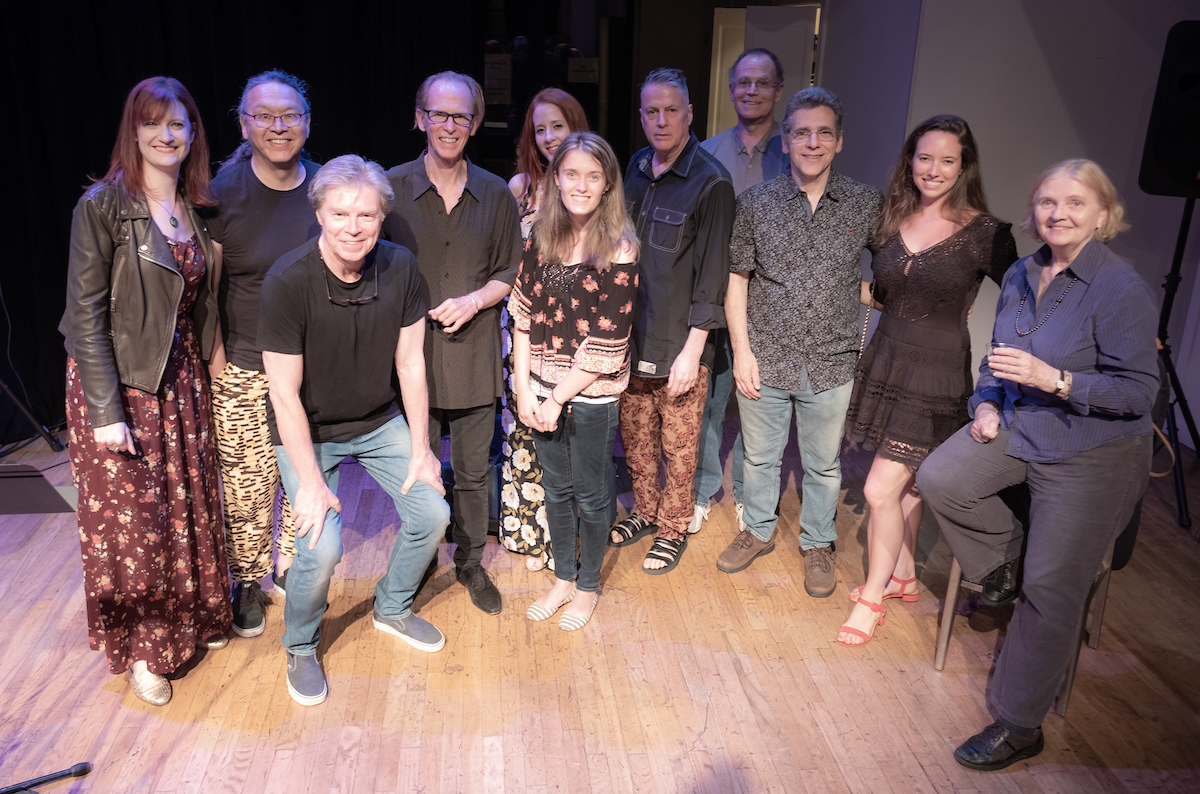
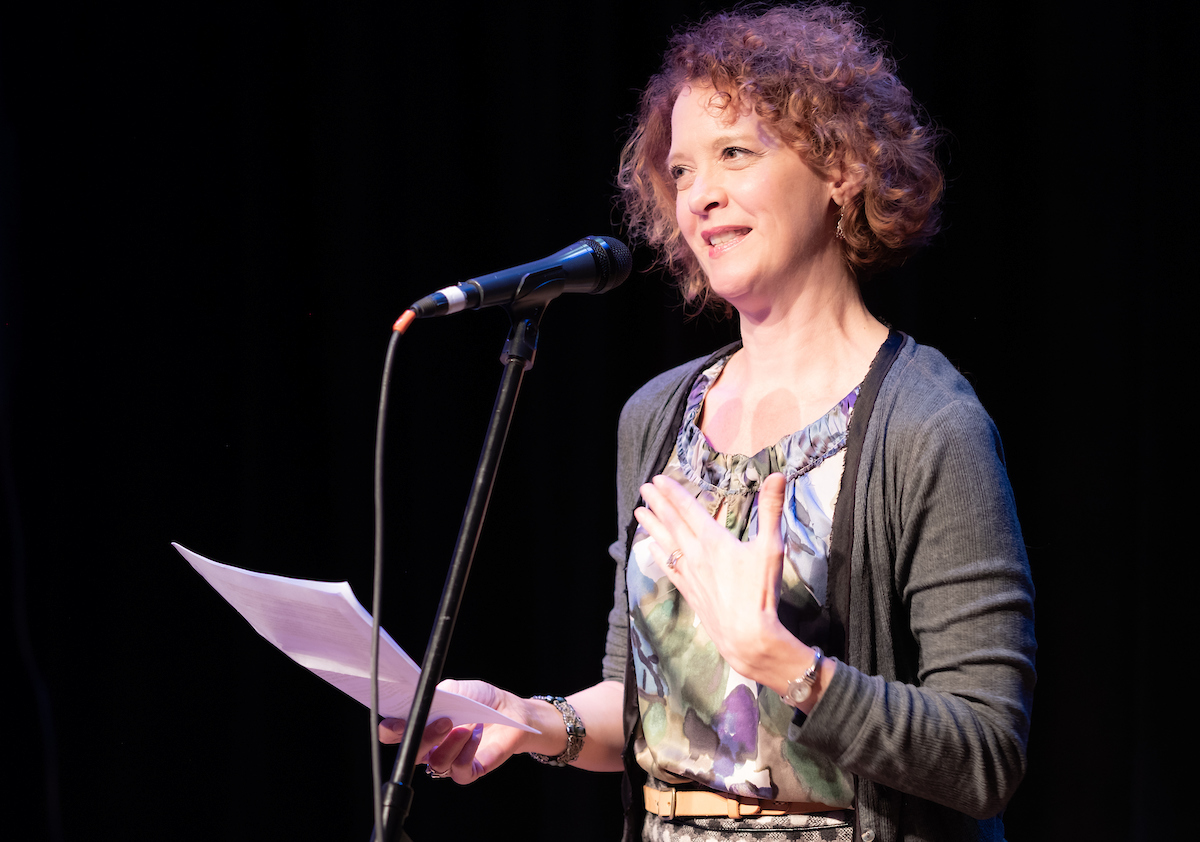
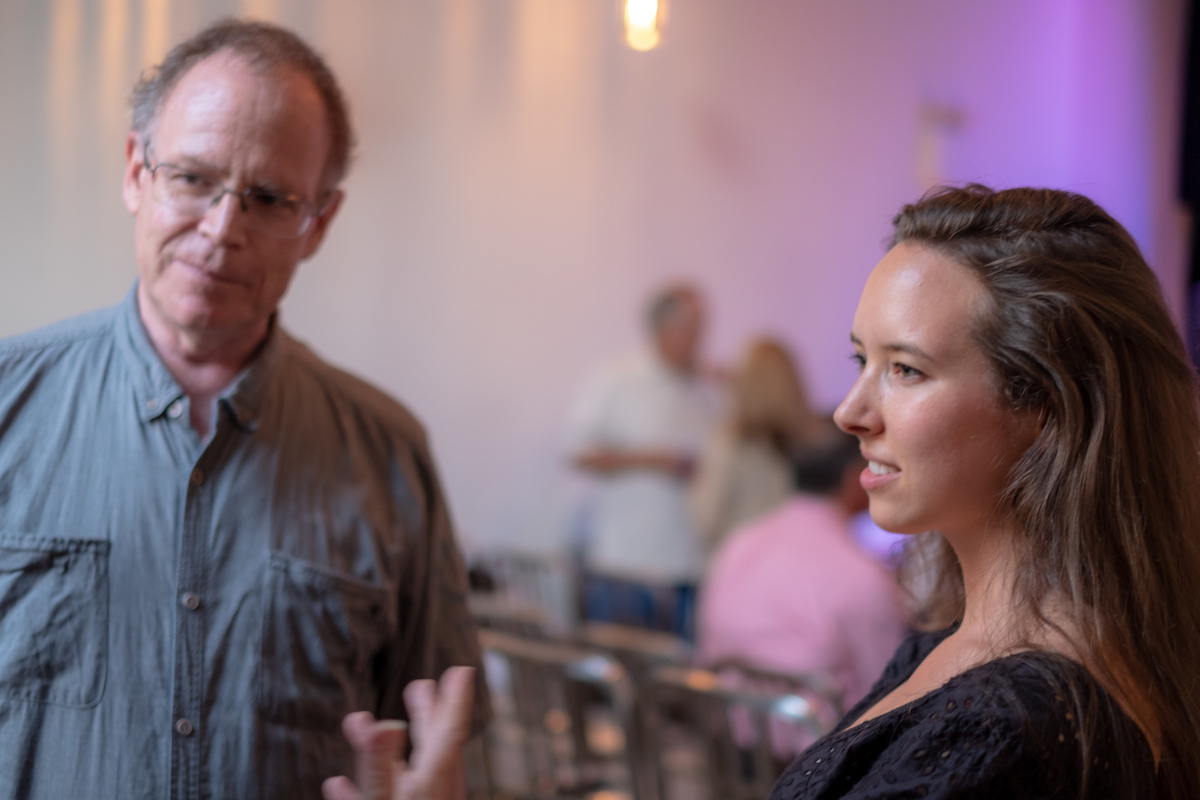
Peter Nolan and Amanda MotturMichael MullerJillian BuckleyCharles R. HaleNiamh Hyland, Cecil Hooker, Charles R. Hale, Michael Muller, Amanda Mottur, Jillian Buckley, Peter Nolan, Sam Adelman, David Goldman, Katrina Crawford and Martha PinsonRenata HinrichsSam Adelman and Katrina Crawford
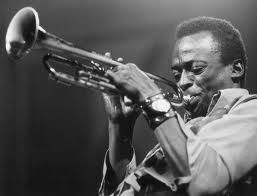
Recently, a few friends and I gathered in a local pub when the subject turned to “silence and space” in art. When one of my friends mentioned that he once heard Pete Seeger say, “It’s not what you put into a song, it’s what you leave out that counts,” the music of jazz great Miles Davis came to mind. When I began listening to Miles I was struck by his ability to do more with silence and empty space than any musician I had ever heard. Miles didn’t fill every second with sound. He understood the power of silence. Listen to “It Never Entered My Mind.”
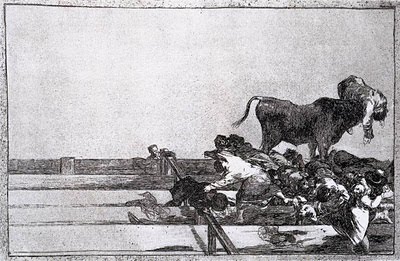
Great artists have the ability to create with less, allowing us our own space to develop our own story: Francisco Goya, in his Tauromaquia series used blank canvas and shadings of grey and white to create the feeling of space. In this sketch, Goya uses empty space to dramatize the fury of a singular moment of horror during a bullfight.
Johan Sebastian Bach understood the power of silence and space as well. During Bach’s B Minor Mass, at the end of the section marked Crucifixus (Crucification), the music slowly sinks into silence, followed by a pause—a moment of contemplation, a moment of space—and then, an explosion of joy and revelation in the Et resurrext. (The Resurrection)
A year ago I received a note from a friend. “Would you read a story I wrote? Something’s missing. I’m looking for a word or words that will give the last few paragraphs more impact, more oopmh. Nothing seems to work.” I read her story and while I claim no great editorial skills, I felt the character development was wonderful, the story had great pace, from the inciting incident, which created conflict, through the midsection’s rising tension, right up until the crisis point or conflict resolution. The ending was perfect. I sent my friend a note. “I could see your character in the last scene and I understood his problem. I knew his motivations and I was there with him. You didn’t have to tell me the character was desperate or frantic, you’d done all the heavy lifting earlier. Your shorter words and shorter sentences built a moment of high drama. Your writing shows great respect for your reader; you allow them the space to be creative; you allow them the space to furnish the emotion. Less is more. In my view, that’s what often makes for great storytelling.”
The power of space and silence were never more evident to me than when I spoke before a gathering of college students and their families a number of years ago. The subject was the value of family stories. I was undecided about including the story of my mother’s sister’s death, a baby who died seven hours after she was born, until the moment I began speaking. I feared that I’d have difficultly controlling my emotions, yet, within a few minutes—I don’t know why—I started telling the story.
As I feared, her death and burial, and the emotions that the story evoked in me, were still too raw. I bowed my head and my eyes filled with tears; I had no idea how I would go on. Finally, I looked up. I was astonished. The entire front row was crying. I regained my composure. I was able to finish my story.
The events of the day became clear to me later in the evening. During the story’s build-up a number of listeners were probably experiencing a bond with my grandmother, grandfather or me. They were sharing a powerful story and many may have assumed the role of one of the characters in the story. Other listeners may have experienced the same wound and so they filtered my story of the baby’s death through their past. When I paused, the listeners may have been provided the space in which they could explore their thoughts, furnish their own emotions, and develop their own stories.
Miles Davis once said, “‘It’s not about the space you play, but the space you leave.” Allowing for space and silence may be one of the keys to effective creative expression, not only for the artist, but the artist’s audience as well.
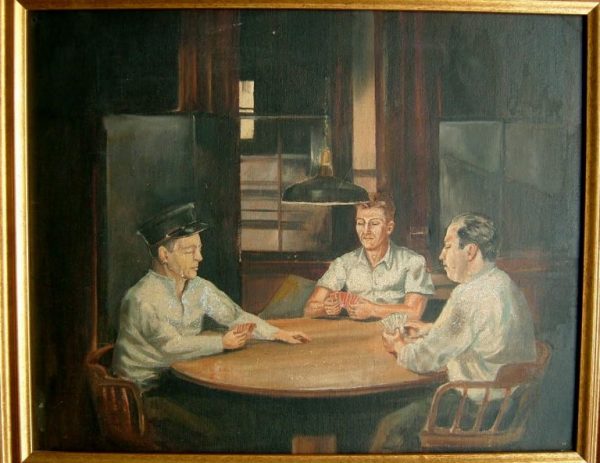
When I began researching my family history I discovered that there were few mementos from the past. There were no letters, only a few old photos—one may have been taken in the 1890’s, and only a few before 1930–a 1913 funeral receipt and an oil painting. The painting captures a nighttime ritual, three NYFD firemen from Engine Co. 14, including my grandfather, (right), sitting around a table, playing poker.
The painting hung on a wall in my grandparents’ NYC apartment and other than Grandpa Charlie using it as a prop for one of his riotous tales, I didn’t know much. I knew that a fireman, Edward Brady, painted it but I never gave much thought to the history of the painting.
As I searched for links to the past–events that would elucidate my ancestors’ space and time–I began considering the painting. I imagined, given my grandfather’s appearance, that it was completed in the nineteen-forties. Once I learned that Edward Brady was a fireman at Engine 14 during the early forties, I was confident in my dating of the painting. As I studied, what I call “Firemen Playing Cards” and American art and artists of that period, I also learned the history behind the style in which Brady painted. It was a school of painting, very different than a generation earlier, and a style that enabled Brady to capture that singular moment in my grandfather’s life.
At the turn of the 20th century American Artists and photographers rebelled against the predominating art of aristocratic portraiture. A new style of painting developed, which was loose and impressionistic, and based on a new subject matter: modern life. Artists developed an interest in human elements: every day subjects in dramatic light. Art became a revelation of life’s experience, both the exciting and the mundane. This school of painting became known as Ashcan Art and included artists such as Robert Henri, John Sloan and George Bellows. Two artists who were greatly influenced by this style of painting, both of whom were associated with New York schools of art during the developmental period of this style, were Edward Hopper and Guy Pene du Bois.
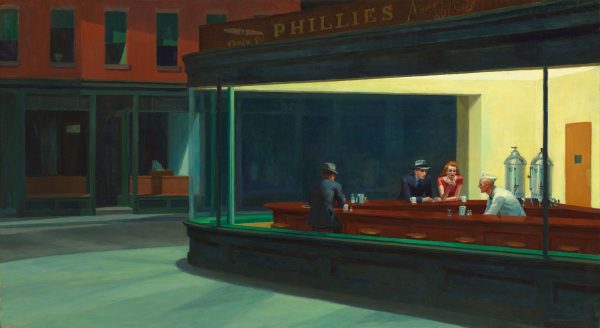
As I studied “Firemen Playing Cards” in greater detail, I noticed that there was a similarity in style or at least a suggestion of Edward Hopper’s painting, “Nighthawks.” Deliberate and spare, each painting captures a singular New York moment in which three New Yorkers seem lost in their thoughts, anonymous and uncommunicative. The diner’s harsh electric light sets it apart from the dark night outside, as does the softer light emanating from the hanging lamp over the poker table.
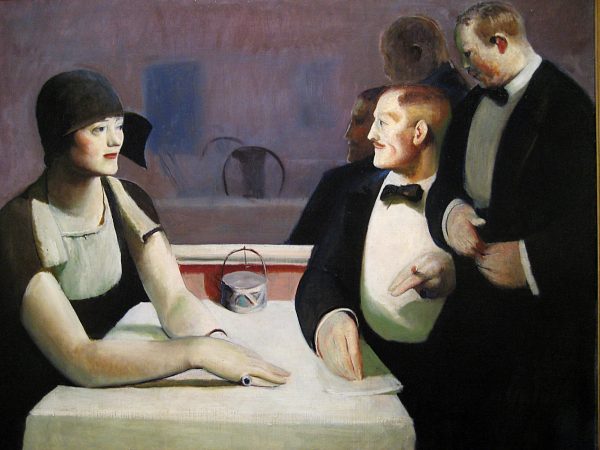
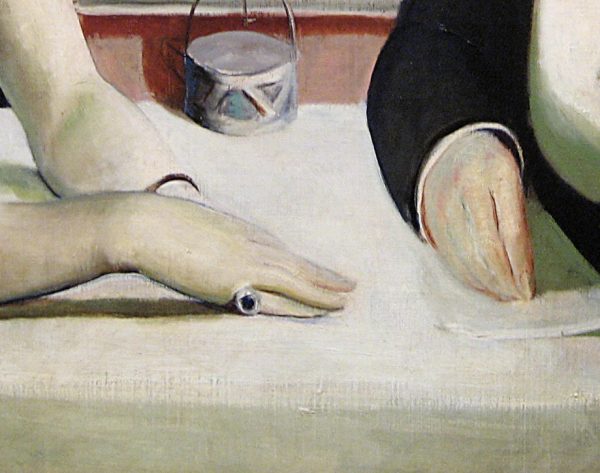
Brooklyn born, Guy Pene du Bois who, like his good friend Hopper, depicted narratives of inaction and themes of emotional disengagement, differed in style. While Hopper was interested in capturing moments of solitude, using bold, simplified forms to infuse his scenes with drama, du Bois used smooth curves striking a balance between abstraction and realism. And while at first glance there appears to be no similarity in Brady and du Bois’s work, there is one commonality: the hands.
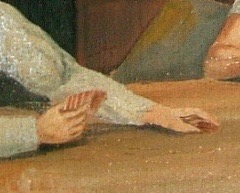
I’d always believed that Fireman Brady could not paint a pair of human hands. The firemen’s hands are nothing like I’d expect them to be, strong, large and rugged, but rather they look childlike and small.
But then I look at the style in which du Bois painted hands and I wonder if Brady was familiar with du Bois? The hands are almost identical. Was Brady familiar with the school of painters who had studios on 14th St. and Union Square, a few blocks from Engine Co. 14, which is located on 18th Street. Did he take lessons at any of these art leagues?
I don’t remember hearing Edward Brady’s name when I was a child. I noticed his name on the painting after his art was bequeathed to me a number of years ago. Looking through old firehouse logs of Engine 14 I was able to determine that Brady and my grandfather were fellow firefighters. And now I stare at the painting every morning, grateful that my grandfather’s friend, a man with whom he risked his life fighting fires, captured this singular moment in my grandfather’s life.
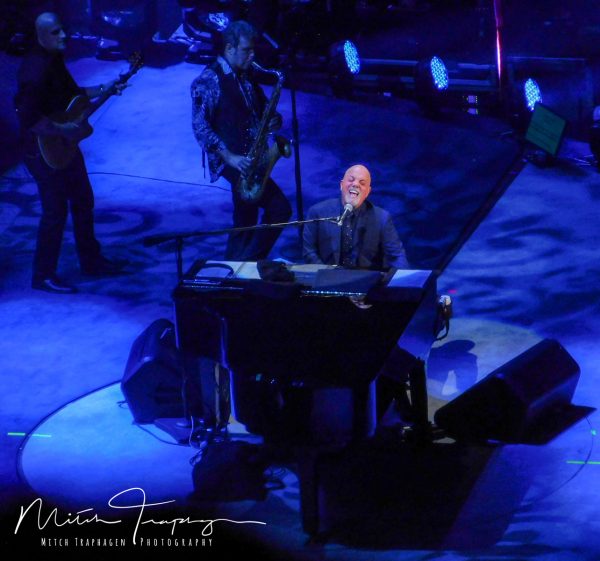
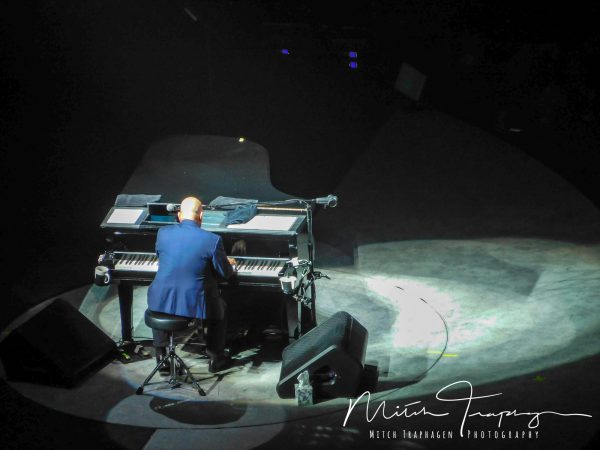
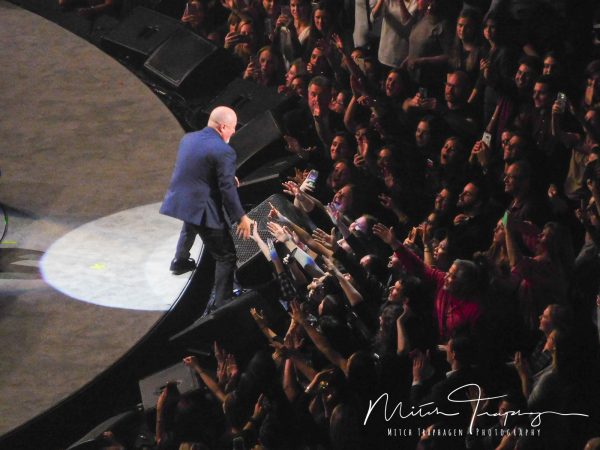
Billy Joel performed his 37th consecutive sold-out monthly show at Madison Square Garden on Jan. 11, 2017. When he began, he said he would keep playing until people stopped showing up. There is no sign of that happening. His 41st concert was just announced.
Billy Joel at Madison Square Garden
It would be hard to argue that he needs the money. He is among the best selling recording artists in history. But he is a New Yorker through and through. Born in the Bronx 67-years-ago, Madison Square Garden is in his hometown; it’s his backyard. And for many artists, Madison Square Garden represents the high bar of a goal of which dreams are made. It is a venue known around the world. Performing there places one in a very rarified club.
Now entering my third year as a member of Artists Without Walls, I’ve seen a number of artists that could be playing at Madison Square Garden. For those artists, having seen them perform at an AWoW monthly showcase, the stretch to MSG is not a long one from my outside perspective. But for the artists, it may well appear differently. For them, it is a matter of choosing the path of the heart, and making the sacrifices, often far more than most people could bear, in reaching that stage.
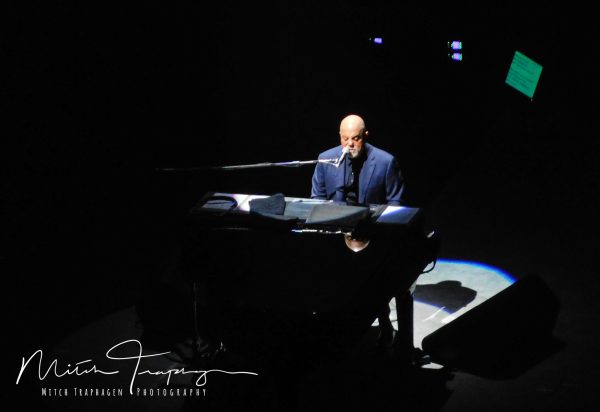
The Piano Man, Billy Joel
Billy Joel made sacrifices. He was busy performing and didn’t actually graduate from high school until…1992. Was it worth it? In terms of wealth and fame, no doubt it was for him. But he has also long suffered from clinical depression, including after September 11, 2001. And yet he continued. He wants to perform. He wants to play until people stop showing up.
What determines what is “worth it” is the soul of the artist in many cases. Some are lucky financially. Sometimes the sacrifice is simply too much, when living indoors and having regular meals must be chosen over someday dreams of 21,000 people at MSG cheering you on.
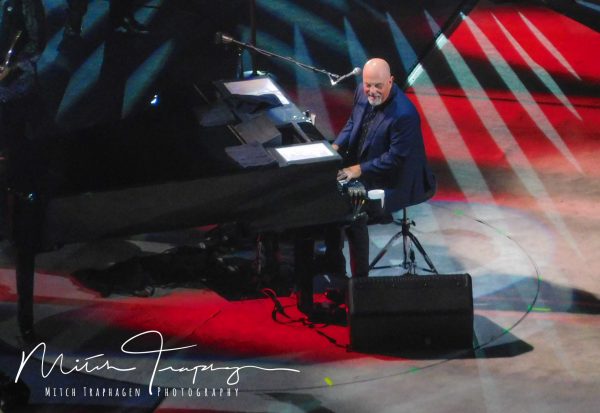
Billy Joel at Madison Square Garden.
Many years ago when I played in a rock band at the tail end of the disco era, we used to joke that dinner for musicians meant going into a diner, ordering a bowl of hot water and grabbing the ketchup bottle on the table. For too many artists today, that probably isn’t far from the truth.
During the concert Billy at times would stop and ask, “Do you want hear this song?…hitting a few keys…or this song?…hitting different keys — but both songs iconic for millions of people encompassing generations.
Billy Joel at Madison Square Garden
He spoke of his songs and albums. At one point, he mentioned an album from the mid-70s and asked the crowd if anyone had it — and quickly followed up with, “Don’t worry. It wasn’t one of my best. I don’t even have that album.”
In the end he played for two and a half hours. There were songs that he likely felt he had no choice but to play — the audience was surely expecting them. But he also mixed it up with some Stones and Led Zeppelin. He has long been a Led Zep fan.
There are any number of artists with AWoW who either have or will someday play on that stage or one equal in stature. There are any number of artists who will perform at the Richard Rogers Theatre on Broadway or in front of movie or television cameras, who may one day change lives while playing at the Rockwood Music Hall or Cafe Vivaldi.
Billy Joel. Mitch Traphagen Photo
There is a reason Billy Joel is performing monthly shows at MSG and it probably doesn’t have much to do with money. There is something else; there is pure, driving passion and there is an “it” factor. Artists Without Walls’ cofounder Charles R. Hale understands it; he is himself an artist, after all. And thus there is a reason such talent takes the stage at the Cell every month for the AWoW showcases. There is a reason such talent exists at all.
From Billy Joel to the many artists with AWoW, from MSG to the Cell, walls don’t matter. The words, the music, the talent…it is in the souls of the artists.
She was the first person I met at my first first Artists Without Walls Showcase at the Cell Theatre. As I made my way to a seat next to her, she just said, “Hi, I’m Deni!” I knew there was something special about her…she appeared to be a bright ray of light with red hair. We talked about music for a few minutes. It wasn’t until later, when I Googled her name, I found out how she could have introduced herself. She could have said, “I once played for the President and First Lady at the White House.” She could have said, “I’m actually kind of famous and have CDs out.” She could have said a lot of things but she didn’t. And Deni Bonet was my introduction to AWoW… It turns out that she wasn’t alone in her grace, modesty and extraordinary talent. There aren’t many like her but there are a few. And they often appear at the Cell…
The chatter isn’t quiet but it isn’t loud; it has a feel-good quality to it. It feels like home. Even for those stepping into the theater for the first time, there are no strangers here. There are no hurdles to conversation, whether in getting a glass of wine or a bottle of water or just joining on any number of loose groups of people talking. Many times the artists are among them.
It is the last Tuesday of the month. And at the Cell Theatre in Chelsea it is the night for the Artists Without Walls Showcase. It is a showcase of incredible people and amazing talent.
Niamh Hyland is a wunderkind with sparkling eyes and a warm heart who could have been an attorney, a business executive, a show host, a Ted Talk vet, or a singer with a voice running an incredible spectrum. Actually she already is all of that. And despite all she is and has accomplished, she still has her dreams; and she works hard to help others achieve their dreams. Niamh is a young woman with an old soul, because seemingly only that could explain her insight and wisdom.
Charles R. Hale, a man of culture and taste who puts on no airs while tracing his roots to the tenements of Lower Manhattan. He, too, could have been anything, and he certainly was something of importance, and in the end he chose the arts, creating an organization to elevate and promote artists; and to continue searching his past, unearthing the lessons his forebears learned. The lessons are often still applicable to all of us today. He has shown that even trailblazers are often able to benefit from a path cleared a century or so ago.
AWoW Member and Sony recording artist Deni Bonet
AWoW is a brainchild from Charles. That may sound like a funny word but is is apt. He is much like a father to the members. He is proud of the successes and worries about their hurdles and, despite having an incredibly busy life, he is tireless in promoting the artists and their events.
Charles R. Hale and Niamh Hyland are the co-founders of Artists Without Walls.
When he’s not somewhere else in the world applying his talent and art to sound production, Emmy Award winner Paul Bevan is comfortably behind the mixing board, adjusting and tweaking the sound to optimize each performance. He makes it look easy but it’s not. A typical showcase could include everything from an author reading from a newly released book, to actors performing a vignette of an emotional play, to an amazing, emerging rock band. He probably isn’t working with the high level of equipment he is accustomed to but he makes no complaint. Paul’s heart and soul is in the sound and equipment matters less in his hands.
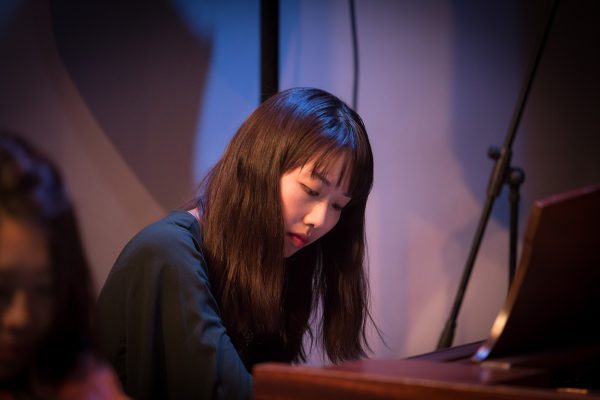
Miho Hazama at the grand piano in the Cell Theatre, while also conducting artists performing a symphony she composed.
And then the lights dim and the comfortable, not quiet, but not loud, din abates to silence. The show is about to begin.
The Cell Theatre in Chelsea is a special place. In the heart of Manhattan, the center of the known universe, it is the usual home of the monthly Artists Without Walls showcases.
Charles and Niamh are on center stage to introduce the first artist. Charles provides some background, someone amazing is about to take the stage. Niamh squints to see past the stage lights into the crowd…and then she smiles.
And the show, which is better than any show in the past and will only be topped by the next, begins…
Whether an artist or someone who loves the arts, we would welcome you to join Artists Without Walls. Just click on the “Become a Member” link. We’re looking forward to seeing you at the Cell!
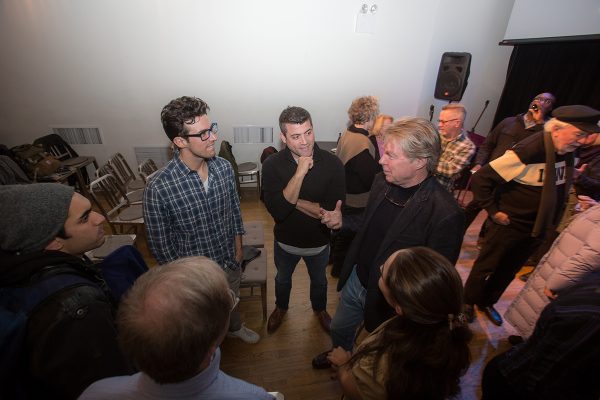
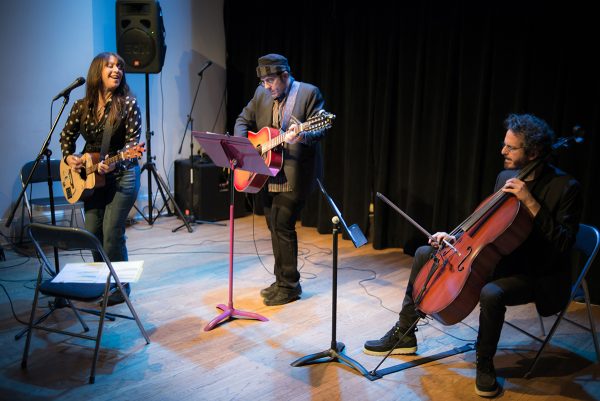
Artists Without Walls co-founder Charles R. Hale chatting with artists and guests at a recent Showcase at the Cell.Renowned musician (and photographer) Dina Regine performs with Mark Plati on guitar and Noah Hoffeld on cello at an AWoW Showcase.
I’ve often wondered what it must be like to live one’s entire life in a small town, surrounded by the same sights and sounds, day after day. And now I realize that my ancestors, living in the crowded and congested tenements of lower Manhattan, shared a parallel existence with those who have done that. “A bell for birth, a bell for marriage, a bell for death.” I had never considered the universality of their experience.
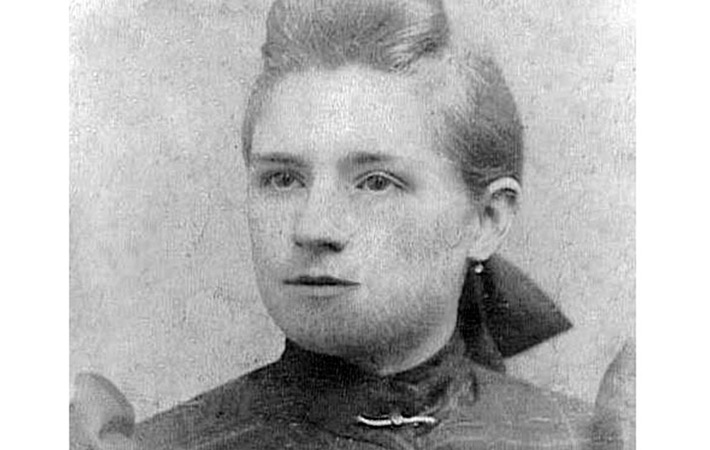
Click here for the article about my great grandmother, Margaret Horrigan, as it recently appeared in Irish Central.
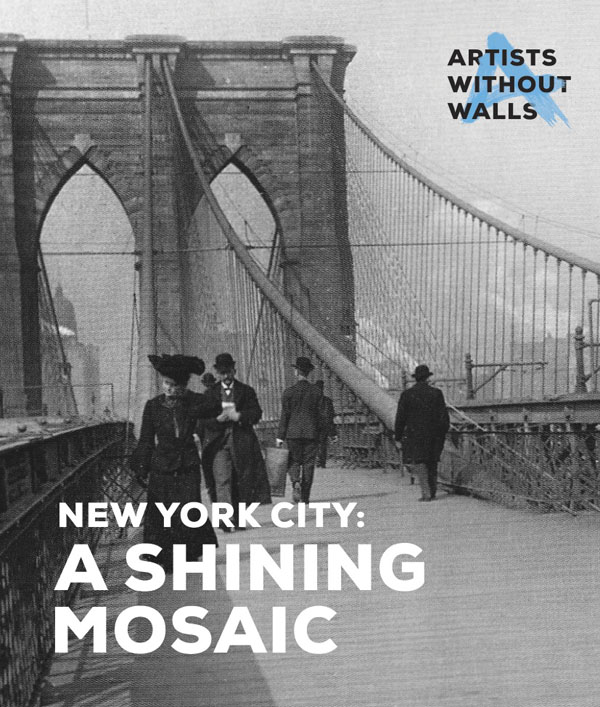
Artists Without Walls is pleased to announce that Julie Kline will be directing our presentation, “New York City: A Shining, Mosaic,” as part of Origin Theatre’s 1stIrish Fest on September 27, 7:30pm at Pier A, Harbor House, NYC.
Julie Kline
Julie is a Brooklyn-based actor, director, writer, and producer of new works for the theater. As a director, Julie developed and directed Erin Layton’s MAGDALEN (Lyth Arts Centre, Scotland; Edinburgh Festival Fringe 2015), Melissa Ritz’s BOMBSHELL OF RHYTHM (Soho Playhouse), Elizabeth Hess’ SPOILED (Stage Left), Kristen Palmer’s THE STRAY DOG (Rising Phoenix Rep) and Jamie Cowperthwait’s HUNTINGTON (Judson Memorial Church).
Julie also conceived and directed SENIORS AND THE CITY in collaboration with oral historian Liza Zapol – a series of original theater works performed by Manhattan seniors based on their life-stories, supported by the Lower Manhattan Cultural Council. She also devised the latest incarnation of this special brand of senior center – ACTING OUT! – in residency at Stanley Isaacs Senior Center with Roots&Branches Theater in association with the Department of Cultural Affairs, the Department of the Aging, and the Distracted Globe Foundation.
As an actor, Julie has appeared in new works with Rising Phoenix Rep, 3Legged Dog, Ensemble Studio Theater, the DC and NYC Fringe Festivals, Ensemble Studio Theater, HERE Arts Center, the Japan Society, and Steppenwolf Theater. Julie is a former literary manager at Rattlestick Playwrights Theater, an Artistic Associate of Rising Phoenix Repertory, and an Artistic Associate for Roots&Branches Theater, where she leads inter-generational theater performances and workshops across New York City. Julie received a BFA in Acting from The Theater School, DePaul University in Chicago.
“New York City: The Shining Mosaic” will be presented at Pier A, Harbor House, 22 Battery Place, New York City, September 27, 7:30pm. For further information click here: For tickets, which are $15 with a small origination fee click here. If tickets are available the night of the show they will be $20 at the door.


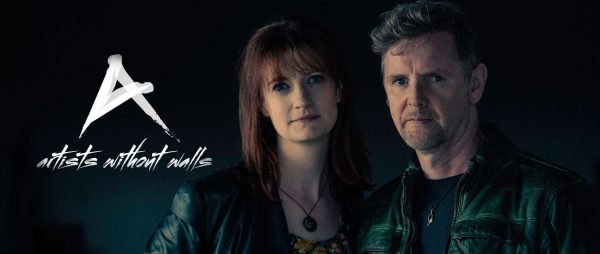

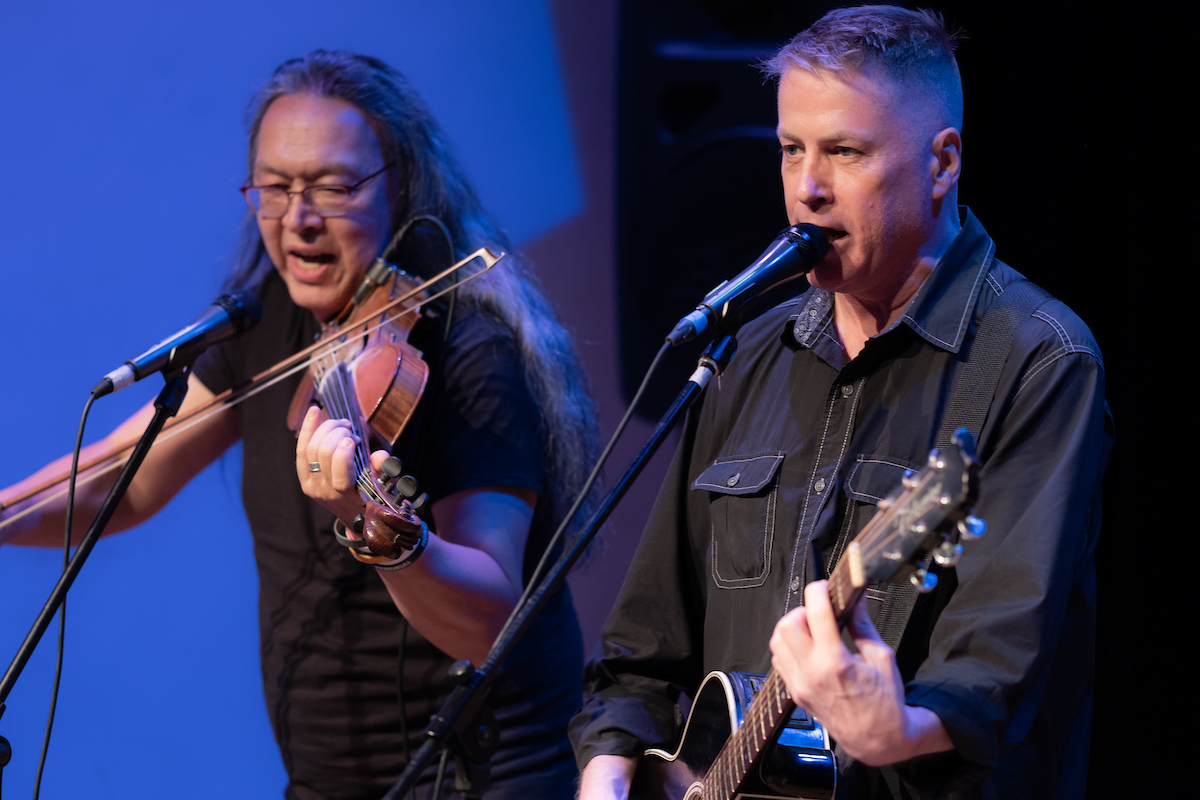 Cecil Hooker and Peter Nolan

 Great artists have the ability to create with less, allowing us our own space to develop our own story: Francisco Goya, in his Tauromaquia series used blank canvas and shadings of grey and white to create the feeling of space. In this sketch, Goya uses empty space to dramatize the fury of a singular moment of horror during a bullfight.
 right up until the crisis point or conflict resolution. The ending was perfect. I sent my friend a note. “I could see your character in the last scene and I understood his problem. I knew his motivations and I was there with him. You didn’t have to tell me the character was desperate or frantic, you’d done all the heavy lifting earlier. Your shorter words and shorter sentences built a moment of high drama. Your writing shows great respect for your reader; you allow them the space to be creative; you allow them the space to furnish the emotion. Less is more. In my view, that’s what often makes for great storytelling.”
 As I feared, her death and burial, and the emotions that the story evoked in me, were still too raw. I bowed my head and my eyes filled with tears; I had no idea how I would go on. Finally, I looked up. I was astonished. The entire front row was crying. I regained my composure. I was able to finish my story.
 As I studied “Firemen Playing Cards” in greater detail, I noticed that there was a similarity in style or at least a suggestion of Edward Hopper’s painting, “Nighthawks.” Deliberate and spare, each painting captures a singular New York moment in which three New Yorkers seem lost in their thoughts, anonymous and uncommunicative. The diner’s harsh electric light sets it apart from the dark night outside, as does the softer light emanating from the hanging lamp over the poker table.
 But then I look at the style in which du Bois painted hands and I wonder if Brady was familiar with du Bois? The hands are almost identical. Was Brady familiar with the school of painters who had studios on 14th St. and Union Square, a few blocks from Engine Co. 14, which is located on 18th Street. Did he take lessons at any of these art leagues?
 I don’t remember hearing Edward Brady’s name when I was a child. I noticed his name on the painting after his art was bequeathed to me a number of years ago. Looking through old firehouse logs of Engine 14 I was able to determine that Brady and my grandfather were fellow firefighters. And now I stare at the painting every morning, grateful that my grandfather’s friend, a man with whom he risked his life fighting fires, captured this singular moment in my grandfather’s life.