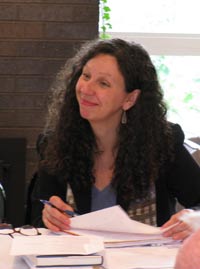
 Who is Angela Alaimo O’Donnell?
I’m a writer, a poet, a teacher, and a talker.
From the time I was a very small child, my poor siblings could attest to this latter identity. In fact, my extravagance of speech earned me a nickname—which I won’t mention here—suffice it to say it isn’t a very complimentary designation.
I mention this quality because it has everything to do with my becoming a writer. Growing up the 4th of 5 children in a noisy and chaotic Italian-American household (Italians, chaotic?), talking was a way of getting—and keeping—people’s attention.
I still “dearly love to talk,” as Thoreau says, but writing has become my favorite way of using language to discover what I know, think, and believe. The opportunity to speak one’s mind and then to make mere air (that’s all words are—air!) concrete is wonderful enough—and then to work at honing and shaping those lumps of language until they express some compelling piece of truth is an endlessly engrossing, exciting, and energizing activity. I may dearly love to talk—but I live to write.
Tell us about your published works:
 I’ve published five books of poems. Two chapbooks, MINE and Waiting for Ecstasy, and three full-length collections, Moving House, Saint Sinatra, and, most recently, Waking My Mother. Each of my books is an embodiment of my various obsessions.
MINE and Moving House are composed of mostly autobiographical poems. I grew up in a loving but highly dysfunctional household in the coal-mining country of Northeastern Pennsylvania. It was an unglamorous place and we led an unglamorous life. We were second-generation Italians—my grandparents emigrated from Gavignano and from Montedoro, Sicily to become coal-miners and businessmen. (I won’t go into the various forms “business” took.) The formative experience of my childhood was the sudden death of my father when I was 8 years old, leaving my mother a pretty, young widow with 5 children to feed and no marketable skills. We all worked to support the household (I’ve been continuously employed since age 13) in attempt to hold on to what little we possessed. The title of my first book, “MINE,” honors the powerful need that poor people have to lay claim to a home, a place, a family as a means of grounding themselves in the world. The title of my second book, “Moving House,” acknowledges the impossibility of that possession—eventually, it slips away, no matter how tightly we hold on. In some ways, both books are meditations on not being at home in the world.
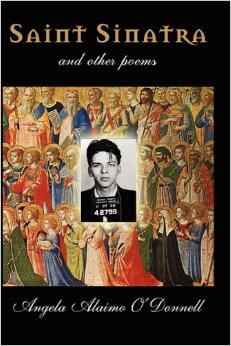 Saint Sinatra reflects another obsession of mine—the saints. Growing up Italian-American and Catholic, we weren’t as conventionally observant as our Irish-American neighbors, but religion was part of our everyday life. Meals were sacraments—we engaged in them fervently, ate & drank with awe & devotion. Family was sacred—no institution or casual relationship trumped it, including the Church. (Among my mother’s favorite expressions was “Blood is thicker than water”—sacramental language if I ever heard it!) When we prayed, we prayed mostly to the saints. It was as if God was too abstracted to care about what went on in our little lives. The saints, on the other hand, were good listeners. They were mere mortals, like ourselves, flawed and fraught human beings who knew our struggles. My mother’s go-to saint for everything was St. Anthony. Yes, he’s the patron saint of lost things—but, according to her, he could do so much more.
Saint Sinatra reflects both this unconventional devotion to the saints and our quirky, do-it-yourself Catholicism. It is, essentially, a catalogue of rogue saints—the ones who won’t make it to canonization, but, to my mind, are deserving. The underlying premise of the poems is that beauty is as worthy a qualification for sainthood as goodness; thus, practitioners of beauty occupy the niches in my cathedral of saints. These include artists of every sort—writers, painters, composers, musicians, and, of course, singers. The book takes Sinatra as its test case. After all, if there’s room for Frank in the Communion of Saints, there’s room for all of us.
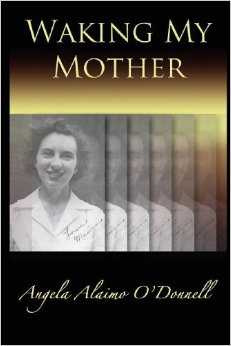 My lastest book, Waking My Mother, is a series of elegies—but it is also an extended meditation (and dramatization) of the complexity of the often fraught relationships between mothers and daughters. The poems attempt to redeem the brokenness that characterized my relationship with my mother—but consolation comes only through desolation. One paradigm for the book is the Inferno: Dante begins his midlife journey in Hell—Paradise comes only much later. It is necessary to begin in the dark places in order to find our way to light. This is the premise of the book, and so its progress is a species of via negativa.
What are you working on right now?
A writer is unhappy unless he or she is engaged in a project—so I’m glad to say that I am currently engaged in three.
The first is a book of poems, tentatively titled, Lovers’ Almanac. After three years of working on a book about death, I was determined to write about something more life affirming—and love is the best antidote to death I know. The anchor piece of the book is a sonnet sequence keyed to the twelve months of the year and is the dramatization of the relationship between two fictional lovers through time. The remaining poems explore the many varieties of love human beings engage in– erotic, filial, fraternal, agapeic, and divine, among others.
The second project is a memoir, of sorts, entitled Mortal Blessings. It is a narrative account of the final weeks of my mother’s life and of the makeshift rituals my family developed, quite unconsciously, as we cared for her and eased her out of this life. The book will be published next year.
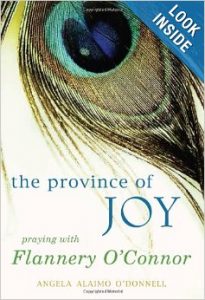
The third project is a brief biography of Flannery O’Connor. It is designed for the reader who might be new to her work and is interested in the connection between her intense spiritual life and her devotion to her vocation as a writer. It will be published in 2015.
 Is poetry your favorite form of expression? Why?
Poetry is terribly necessary. It is the most powerful form of expression we human beings have in our linguistic arsenal. In times of crisis, loss, and agony—and in times of celebration and rapture—we reach for poetry, the only language that can carry the intensity of the emotions we feel. Poetry is, as Donald Hall has stated, “the un-sayable said.” It is extreme language for extreme being.
Poetry is also a form of music—it exists in the space between word and song. The rhythm and rhyme of poetry creates a sturdy structure that can, paradoxically, hold the chaos of human life, or, to use another metaphor, an asbestos container capable of transporting fire. Poetry tames the flame that might otherwise devour. The beauty of the sound of poetry can redeem the ugliest experience, and it makes those experiences bearable.
When I was a child, I wanted to be an opera singer. I loved the sound of the impassioned voices that would come out of the speakers in the Magnavox console in our living room, and I would sing along with them. As I grew older and realized that my voice was not suitable to opera, I knew I had to find another kind of song to sing. Poetry provided me with the peculiar music necessary to me—one that allowed me to be who I was (a talker) but gave me a language that constituted song. At that point (around age 6), I began to write, to find my voice—and I’ve spent much of my life, as any singer does, trying to develop and perfect it.
 Who are the poets/writers whom you admire and who have influenced you?
I’ve been very fortunate to be able to earn a living working at what I love. The only two jobs I’ve ever held have enabled me to do this—as a waitress, I delivered food to people who were very happy to receive it, and as an English professor, I teach great poetry (and prose) to students who are hungry for it, whether they realize it or not. As a result, I spend my days with the writers I love best—and they are many.
In terms of my own development as a writer, my ear—my sense of the sounds of poetry—has been shaped by Shakespeare, Keats, Tennyson, Yeats, Dickinson, Frost, and Heaney; my eye—my sense of what constitutes fit subject for poetry—has been shaped by Dante, Wordsworth, Melville, Whitman, William Carlos Williams, Elizabeth Bishop, and the Gospels; my predilection for the play of paradox in poetry has been shaped by Donne, Herbert, Hopkins, and T.S. Eliot; and my passion for the exploration of women’s lived experience in poetry has been shaped by Edna St. Vincent Millay, Josephine Jacobsen, Denise Levertov, Anna Swir, Sylvia Plath, Louise Erdrich, Kate Daniels, and Marie Ponsot.
It has been said that poetry is a means through which we break bread with the dead. When I write, I feel the presence of all of these poets—both the living and the dead— in the room with me. Their voices inform and inflect my own, and writing enables me to carry on a conversation with them.
 Who is your greatest inspiration and why?
I am inspired by artists who persevere—who keep working at their craft well into middle and old age and who continue to grow and deepen through their work.
For instance, I admire Stanley Kunitz, who lived into his nineties and who started writing his best poems in his seventies. This is also true of the great Polish poet, Czeslaw Milosz. I also admire the late great Seamus Heaney, whose poetry became finer, subtler, with each passing decade.
But my sources of inspiration aren’t limited to poets and writers. I’m much moved by the music of Bruce Springsteen, who reinvents and reinterprets the work he created as a young man to make it fresh and new. His revised performance of “Born in the USA,” for instance, from a bombastic rock anthem to a subtle, moving narrative of our lost generation of Vietnam Vets is profoundly moving—and it is a truer piece of art. For similar reasons, I find the career of Johnny Cash to be a source of wonder. The man could not stop singing, even as he was losing his voice. Listening to his final recordings, you can hear the vestiges of his familiar baritone sound, but you can also hear something new—depth, vulnerability, and courage in the face of coming darkness. I defy any Cash fan to listen to his final recording of “Ain’t No Grave” and not feel the hairs on the back of your neck stand to attention.
What are the top five things you’d like to accomplish in the next five years?
I’m not a planner—I’ve just never been very good at it. I think this has a lot to do with our very strange childhood. We learned early that there were few things in life you could count on, and making plans almost seems a way of tempting fate.
 Dispositionally, I prefer to leave myself open to possibility—the unexpected invitation, the chance connection, the surprise encounter that leads to some wonderful and unpredictable outcome. It seems all of my work has flowed from such moments of gratuitous grace. I’ve written and performed a play in New York, had a number of my poems set to music, collaborated with visual artists, and traveled across the country to some pretty unlikely places to perform my poems.
That having been said, when an opportunity presents itself (and it always seems to), I pursue it with absurd abandon. As my family will attest, I am extreme in all things—and this is especially true when I am working on a project.
As for what I’d like to do in the next five years—Yes! More of the above, please!
What was the best gift that someone gave you that inspired or facilitated an interest in your art?
 Those gifts have been many and multiple—so much so, it is humbling. I’ve been blessed by mentors who assured me of the validity of my voice at key moments in its development, by generous friends and colleagues who have read my work and given me invaluable feedback, by organizations that have given me grants and funded writing residencies, and by editors who have expressed their faith in the poems by publishing them. All of this has given me the gift that every writer needs—community.
Though artists have a reputation as solitaries, and one certainly needs solitude in order to write, the writer’s need for readers and colleagues is just as essential. No one wants to talk to him- or herself. Writing is a radically communicative act, just as surely as speech is. The intimacy that develops between reader and writer creates community, even if it is just a community of two.
Perhaps the best gift writing has given me is this sense of belonging that results from engaging in this special mode of conversation—and I dearly love to talk.
Angela Alaimo O’Donnell Website
Angela Alaimo O’Donnell